

City of Tallinn
Making urban data easier to find, understand and explore through an AI-powered 3D Digital Twin
The challenge
Tallinn already has a 3D Digital Twin, but it is not yet part of most civil servants’ everyday work. Many employees do not know that it exists, while those who use it mainly rely on basic functions such as searching addresses or measuring buildings. The bigger problem is that city information is spread across many maps, databases and professional tools. Employees often need to search several systems or request data from another department before they can complete a task.
The project explored how an AI assistant could make this process easier by finding relevant information and showing it directly inside the 3D city model.
Methods
Interviews, Desk Research, Competitive Audit, Thematic Analysis, Scope Mapping, Wireframing, Concept Testing, Prototyping
Team
Chris Kristjan Kivaste, Estere Estella Mitule, Ahsan Nazir
Duration
3 Months
Research
The research focused on three Tallinn City departments: Urban Planning, Transport, and Urban Environment and Public Works. Their daily workflows, tools, data sources and key challenges were explored to understand where an AI assistant could bring the most value.
→ Competitive audit
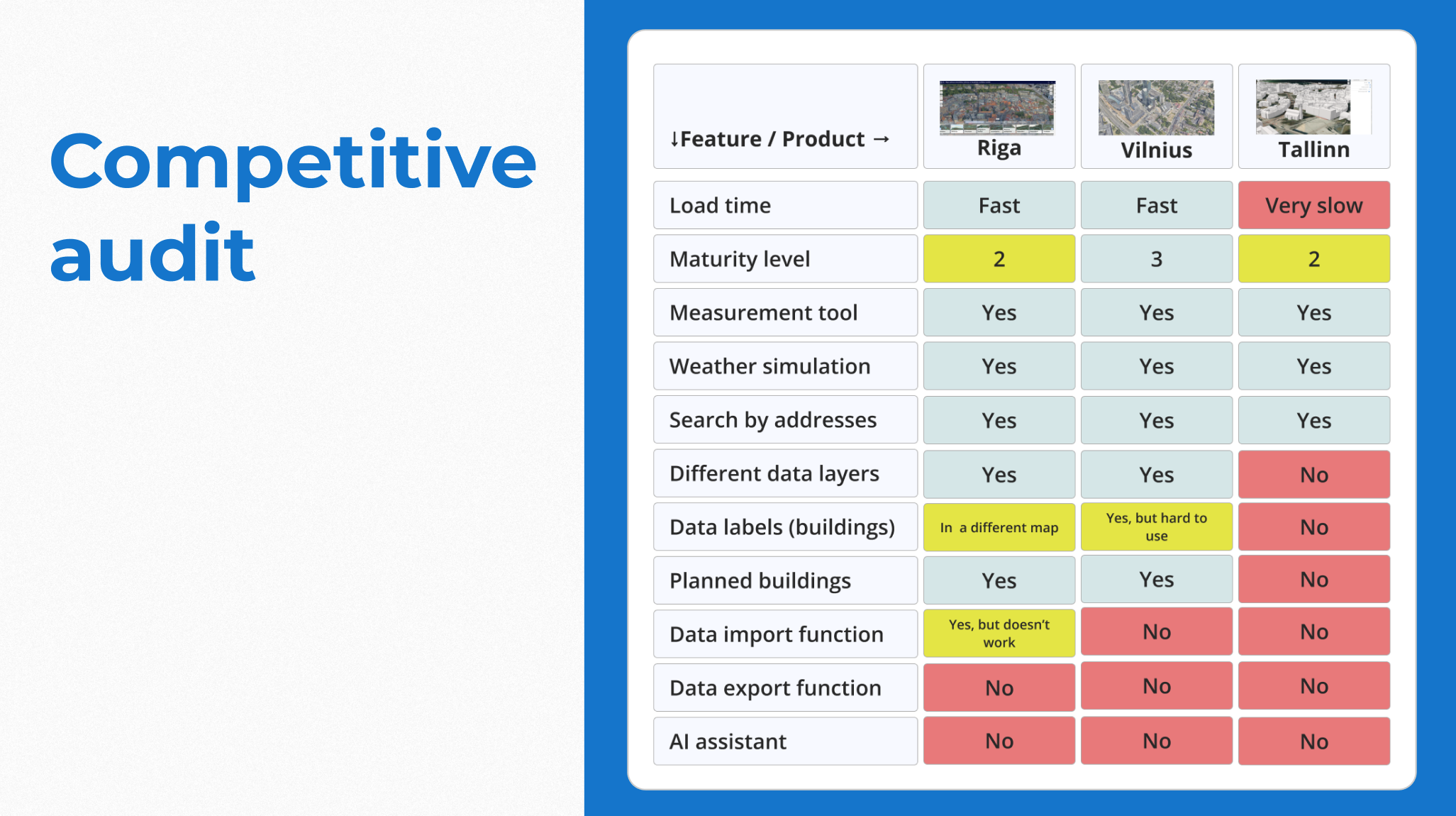
A competitive audit compared the Digital Twin platforms of Tallinn, Riga, and Vilnius to understand how neighbouring cities use similar technologies. The audit showed that all three platforms supported basic functions, while Riga and Vilnius offered more advanced capabilities.
→ User interviews & thematic analysis
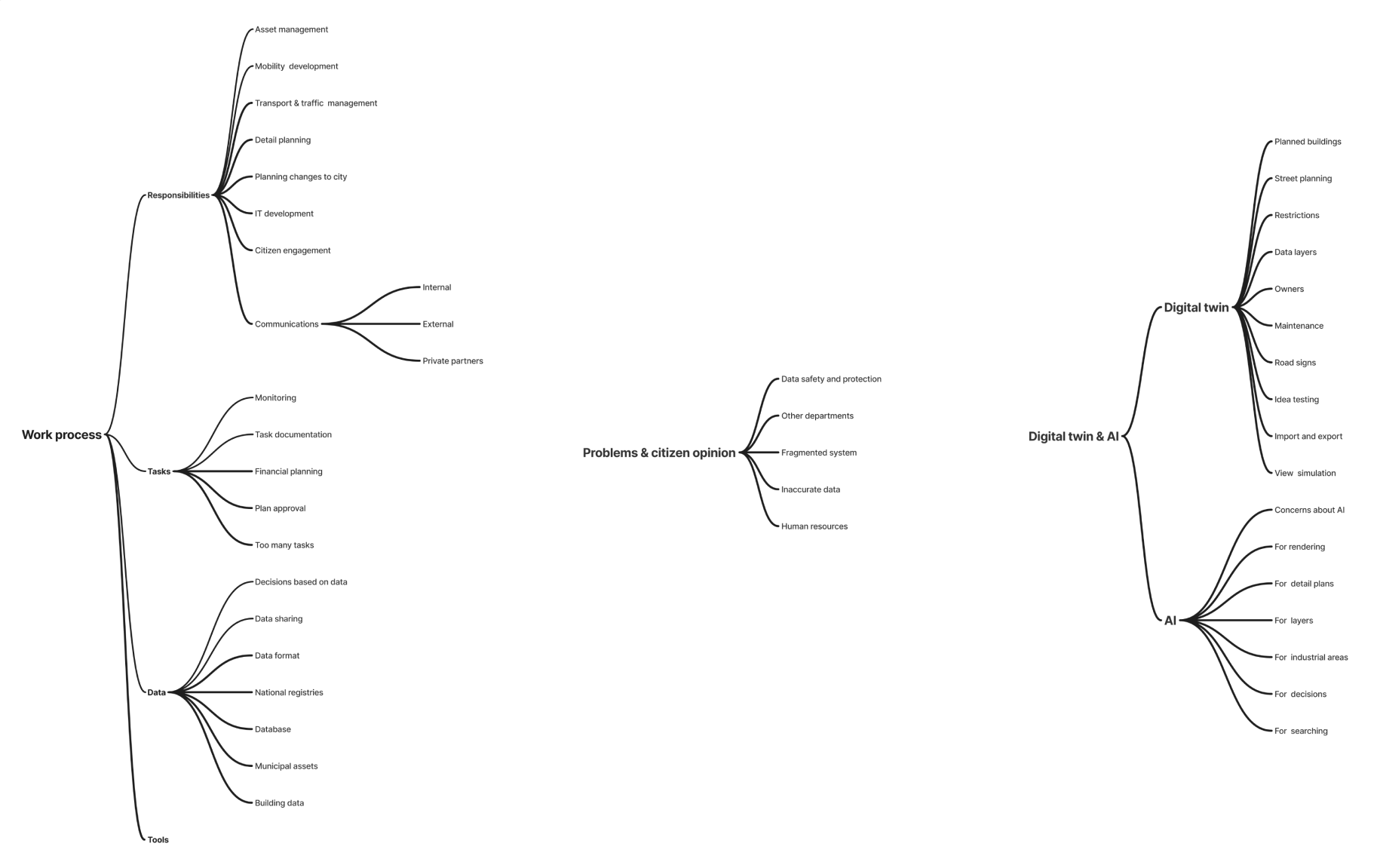
Four civil servants from three city departments were interviewed to understand how the Digital Twin could support their daily work. The research identified one common challenge across all departments: data is spread across different systems.
→ Scope mapping
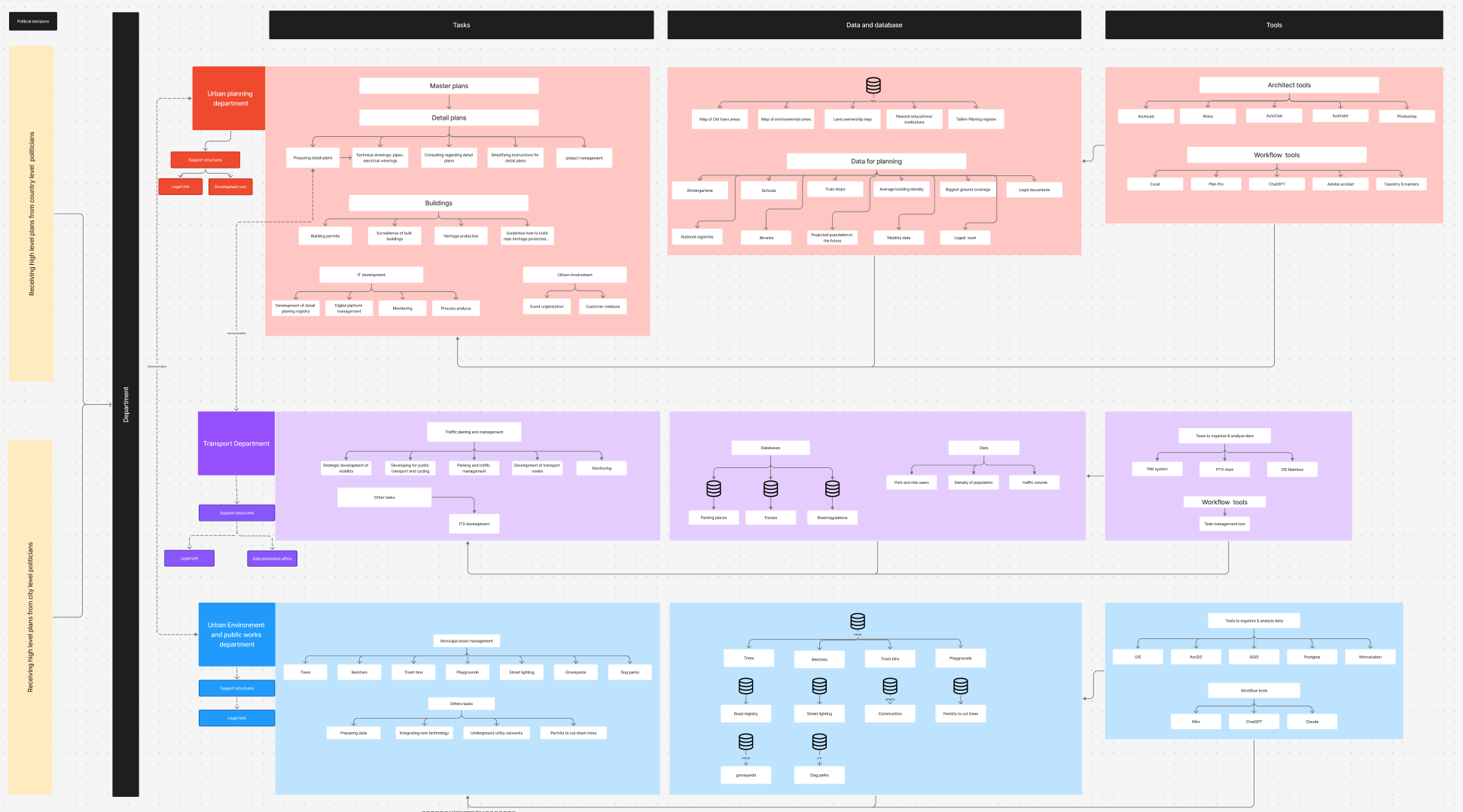
Mapping each department’s workflows, tools and data sources showed that employees had to switch between different systems and databases. Some departments were already using tools such as ChatGPT and Claude, but these tools were not connected to Tallinn’s internal data.
→ Wireframing
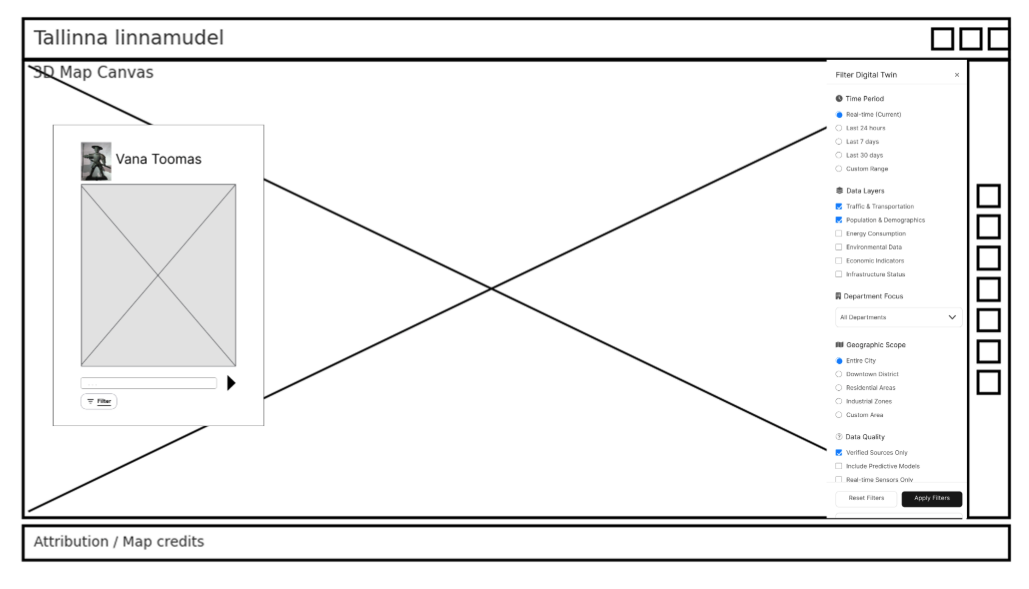
Six wireframe iterations were created in Figma to explore how users could interact with the AI assistant, including asking questions by text or voice, filtering results, viewing answers and checking their sources.
→ Participatory design
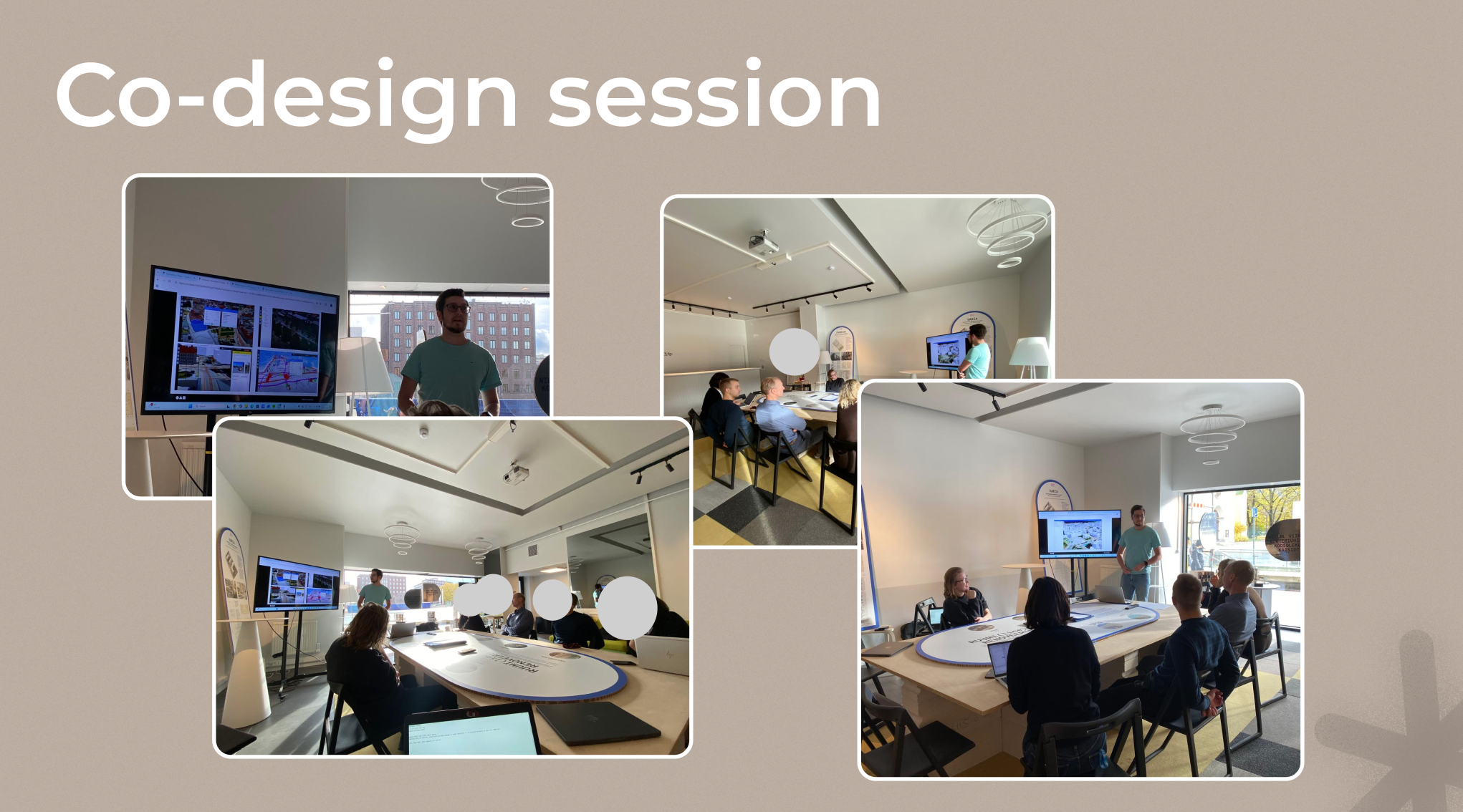
A design session with civil servants helped improve the wireframes and test the concept. Their feedback helped identify the most useful AI features and make sure the assistant supported the real workflows of different city departments.
→ Concept testing
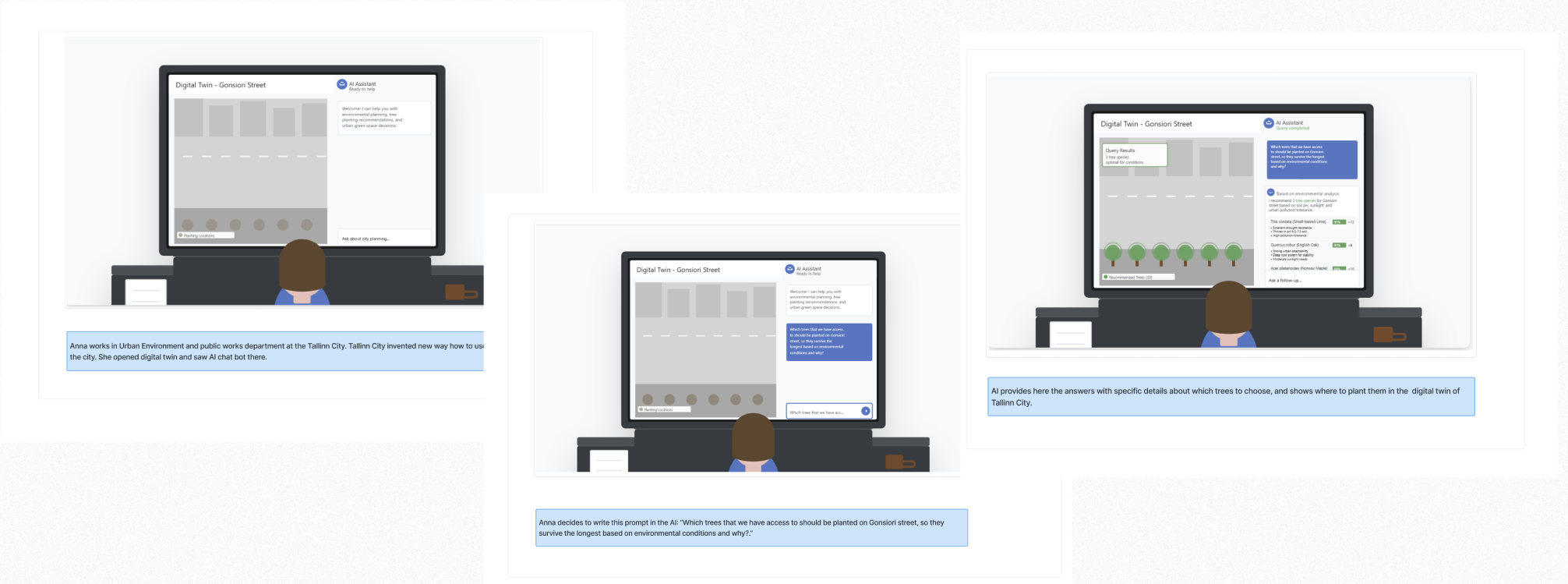
The AI assistant was tested using real city work scenarios to understand how it could support everyday tasks. The testing showed that trust was the biggest challenge and that users needed clear AI answers and reliable city data.
Key Insights
→ Trust is the biggest challenge
Transparency is a key design requirement. Rather than simply receiving an answer, users want to understand the data and reasoning behind every AI response.
→ Too many systems slow down everyday work
Finding city information often means navigating multiple maps, databases and departments. The research highlighted the need for a single entry point that brings this information together in one place.
→ Each department requires different support
Urban planners, transport specialists and environmental employees work with different types of data and terminology. Instead of one generic AI assistant, each department requires specialised support tailored to its work.
→ Answers should appear on the map
Seeing information in context is just as important as finding it. Users expect AI to connect answers with real locations, buildings and city assets inside the 3D model.
→ Users need control over answer depth
Different tasks require different levels of detail. Users expect AI to adapt its responses, providing quick answers for simple questions and deeper analysis for more complex decisions.
Design Solutions
The research revealed that civil servants did not need another map or database—they needed a single way to access city knowledge. The final concept introduced an AI assistant that allowed users to ask questions in natural language, explore trusted city data through department-specific expertise, and visualise results directly within the 3D Digital Twin.
→ AI-powered Digital Twin
Problem – Finding information required switching between multiple maps, databases and departments.
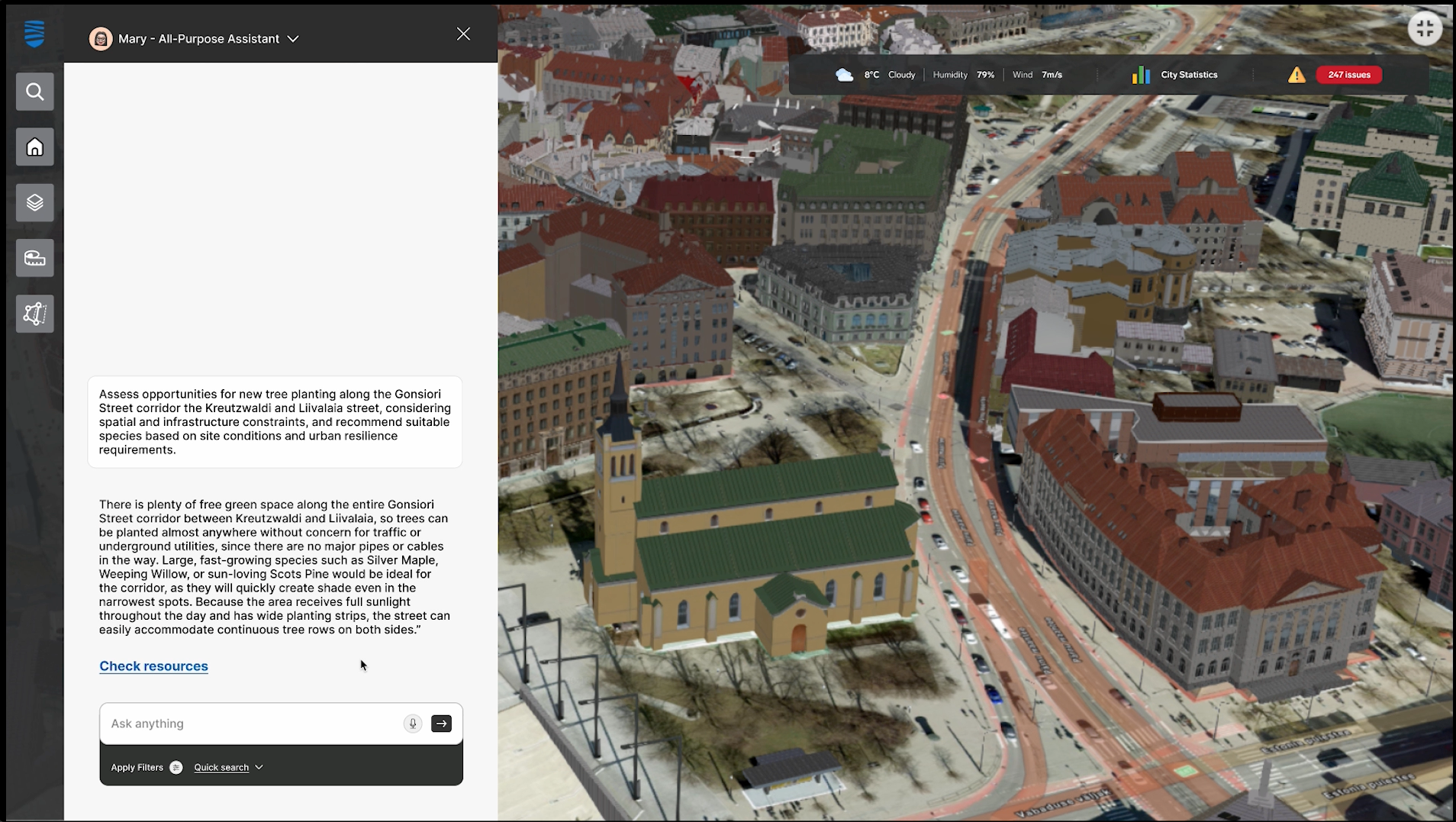
Solution – The Digital Twin was enhanced with an AI assistant that allows users to search city information through a simple conversation while keeping the 3D model visible throughout the interaction.
→ Department-specific AI experts
Problem – Urban planners, transport specialists and environmental employees work with different terminology, data and daily tasks.
Solution – Instead of one generic assistant, the concept introduced specialised AI experts for transport, urban environment, buildings and construction, together with a general assistant. Users can switch experts depending on the task.
→ Flexible AI conversations
Problem – Some tasks require quick answers, while others need detailed analysis before making decisions.
Solution – Users can choose between a short response and an in-depth explanation. The assistant also supports both text and voice input, making the interaction flexible for different working situations.
→ Transparent and trustworthy answers
Problem – Civil servants were interested in AI but did not fully trust its recommendations.
Solution – Every response includes a Check Resources option that explains how the answer was generated and shows the city datasets, documents and databases behind it. The prototype even demonstrates how users can identify and correct an incorrect AI response by changing experts or filters.
Usability Testing
The concept was validated throughout the design process using participatory design, concept testing, and stakeholder feedback. Four civil servants evaluated three realistic scenarios covering Urban Planning, Urban Environment, and Transport. Participants believed the AI assistant could improve everyday efficiency by reducing the need to search across multiple systems. They also emphasised the importance of transparent sources and reliable city data when using AI to support professional decision-making. The feedback informed the final iteration of the prototype.
Outcome
The project explored how AI could make Tallinn’s existing Digital Twin easier for civil servants to use. The research showed that the main challenge was not visualising city data, but helping employees quickly find, understand, and apply it in their everyday work. These insights were translated into an interactive high-fidelity prototype that combines conversational AI with 3D visualisation and department-specific expertise. Instead of searching across multiple systems, civil servants can access relevant information through a single intelligent interface designed around real municipal workflows.
The project presents a research-driven vision for the future of Tallinn’s Digital Twin, demonstrating how trustworthy AI and better access to city data could support more efficient and informed decision-making.